War Dead
A record of those who lost their lives during times of conflict
Scroll sideways to see more columns
| Name | Conflict | Location | Date | Casualty Record | Age |
|---|---|---|---|---|---|
| Sir William de Moleyns | Hundred Years War | Siege of Orleans | 1429 | ||
| Robert 3rd Baron Hungerford (Lord Moleyns) | Wars of the Roses | Battle of Hexam | May 18 1464 | Beheaded at Newcastle | ~35 |
| Sir Thomas Hungerford | Wars of the Roses | Salisbury | January 17 1469 | Beheaded | ~29 |
| Robert Dormer, 1st Earl of Carnarvon | First English Civil War | Battle of Newbury | September 20 1643 | ~33 | |
| Albert Lay | Great War | Flanders | December 12 1915 | Accidentally killed | 20 |
| Aubrey S Gomme | Great War | France | April 9 1917 | Killed in action | 24 |
| William J Claydon | Great War | April 28 1917 | Wounded and Missing | 20 | |
| Frank P Kingham | Great War | Flanders | August 27 1917 | Killed in action | 21 |
| (William) Herbert Smith | Great War | France | March 21 1918 | Killed in action | 33 |
| Albert Richardson | Great War | France | September 11 1918 | Died of Wounds | 23 |
Albert Lay was born in Church Hanborough, North Leigh, Oxfordshire whilst his parents, Albert and Elizabeth, lived at 26 Harlesden Road, Willesden Green in London. Albert senior pre-deceased his son in 1907. Albert Junior lived in Illmere and served as a private in the Oxford & Bucks Light Infantry 5th Battalion. He was accidentally killed in Flanders aged 20 and is buried in Section C, Grave 15 at Potijze Château Wood Cemetery, Ieper (Ypres), Belgium. He is one of two WW1 soldiers remembered on the Ashendon war memorial beside the parish church.
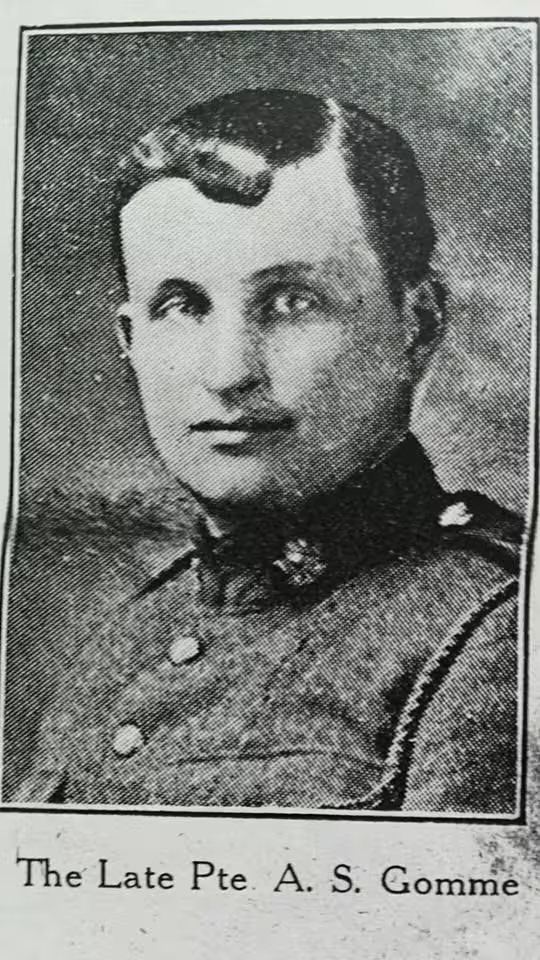
Aubrey Gomme was born at Coldharbour Farm, Ilmer, on 20 August 1892, the son of George and Hannah Gomme. Aubrey was a farmer who had emigrated to Canada early in 1911. He joined the Canadian Infantry, serving as a private in the 21st Battalion of the East Ontario Regiment; the Battalion arrived in England in May 1916. Aubrey was killed in action on 9 April 1917 during the attack at Vimy Ridge. He was 24 years old and is buried at Ecoivres Military Cemetery, Pas de Calais.
William Claydon was born at Bledlow Ridge in 1897. He was the son of William and Sarah Claydon of Ilmer, his father William worked as a horseman. William joined the Oxford and Bucks Light infantry and was killed in action on 28 April 1917. He was 19 years old and has no known grave. Williamʼs name appears on the Arras Memorial, Pas de Calais.
Frank Kingham, born on 25 July 1896, was the son of Fritz and Sarah Kingham who lived at Lower Farm Cottage in 1911 and at the Old Vicarage at the time of his death. He was a carter and stockman for Mr A. Goodchild and applied for Military Exemption in 1916[1]. Frank served with the Gloucestershire Regiment and died of his wounds on 27 August 1917, at the age of 21 years; he is buried in the New Irish Farm Cemetery at Ypres.
The following paragraph under the Horsenden-with-Ilmer parish in the AYLESBURY DEANERY MAGAZINE of unknown date, but between 1920 and 1929, says:
Mr. and Mrs. Fritz Kingham, Ilmer, on the 27th of June received the following letter: "I am directed to inform you that in accordance with the agreement with the French and Belgian Governments to remove all scattered graves and small Cemeteries containing less than 40 graves and certain other Cemeteries which were situated in places unsuitable for permanent retention, it has been found necessary to exhume the bodies buried in certain areas. In the process of exhumation, the grave of Private F. Kingham was located at a point South East of Julien, and his remains have been re-interred in Plot 16, Row A, Grave 19, New Irish Farm, St. Jean, North of Ypres. The new grave has been registered in this office, (52 Baker Street, London). The re-burial has been reverently and carefully carried out." The following day a cigarette case and other relics of their deceased son were forwarded to Mr. and Mrs. Kingham.
Mr Fritz Kingham was described as the churchwarden. The note was written by Rev W. M. Tuke of 4, Priory Avenue, High Wycombe.

Herbert Smith, whose full name is recorded as (William) Herbert Charles Smith, was born in Longwick around 1885 to Charles William and Kate (née Grange) Smith. His father, listed as William Smith in Kelly's 1915 directory, farmed at Ray Farm on the Thame Road. Charles William was born in Aynho, Northamptonshire, while Kate was born in Bledlow. Herbert did most of the work on the 60-acre farm and applied to the local tribunal for exemption from military service in March 1916. He married Elizabeth Rogers, whose mother, Charlotte, was the publican at the Three Pigeons Inn in Longwick. Herbert enlisted at Aylesbury in January 1917, first joining the Oxford & Bucks Light Infantry (service no. 28569) before transferring as a private to the 8th Battalion of the Royal Berkshire Regiment (service no. 37781). He was killed in action on 21 March 1918, the opening day of the German Spring Offensive, when his battalion was in the forward zone and bore the full force of the attack. He was 33 and has no known grave. Herbert is commemorated on the Pozières Memorial in the Somme (Panels 56 and 57), as well as on the Longwick War Memorial and the Princes Risborough Church and Market House memorials. His younger brother, Reginald Wilfred "Dick" Smith, continued farming Ray Farm and died in 1988.
Albert Richardson was born in 1895, the son of Alfred and Alice Richardson. Both father and son worked as farm labourers at Manor Farm, Ilmer, for Alfred Hill. Albert served as a Corporal in the 13th Kings Royal Rifles Corps and died of his wounds in 11 September 1918 at the age of 23 years. Albert Richardson was a bell ringer and active church worker and a special memorial service was held for him at Ilmer Church. He is buried at Ruyaulcourt Military Cemetery, Pas de Calais.
Great War Memorial Tablet
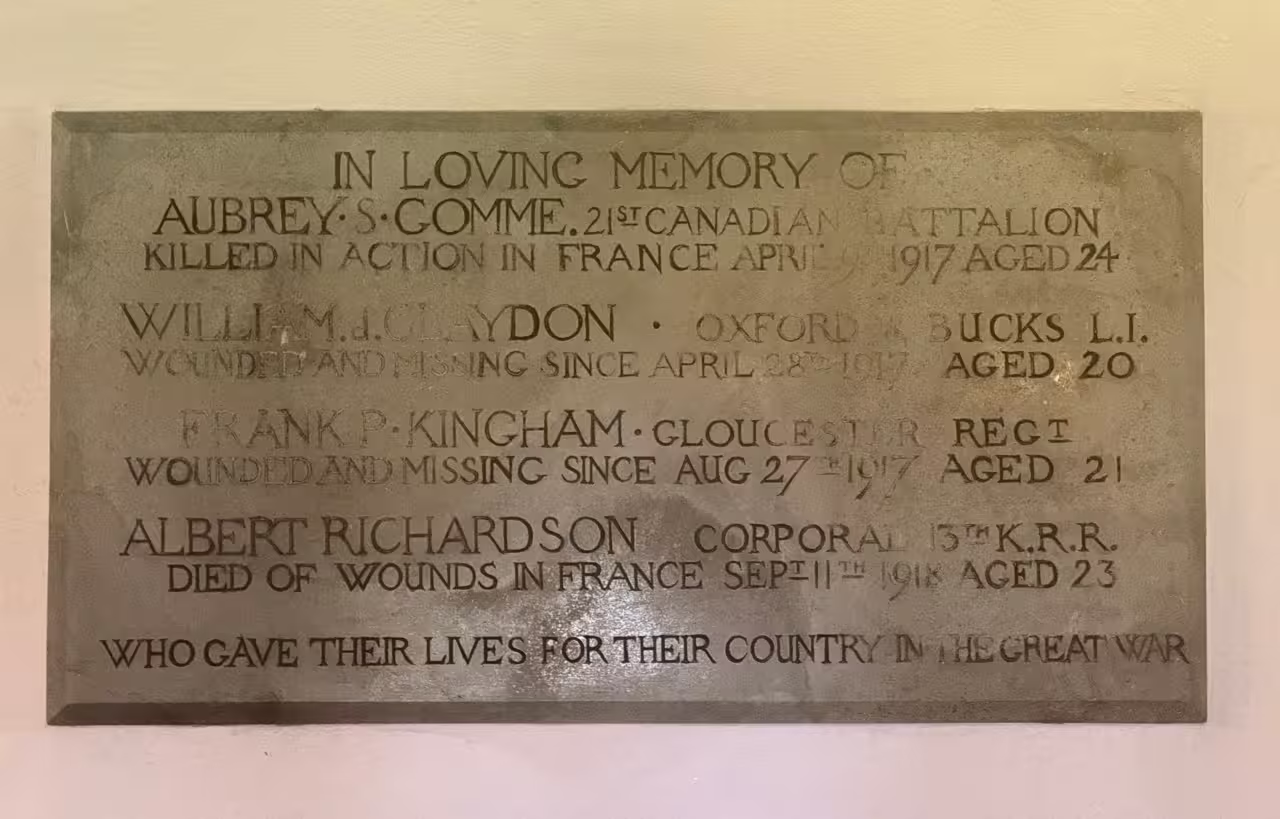 Memorial Tablet, erected 1920
The Ilmer Great War memorial tablet on the south wall inside St Peter's was approved in the vestry minutes of November 1919. It is made of Grey Hopton wood stone[2] and erected after a 30th Jan. 1920 faculty was granted[3]. It was made to a design of Miss E.M. Rope of 404 Fulham Road, London.
Agreed to by the Oxford Diocesan
War Memorials Committee subject
to the slight alteration in the design.
viz: that the top line of the
tablet be made straight. - the
curved line being done away with.
and the little cross omitted *
-Lettering much commended.
C.O. Skilbeck
Member of Oxford Diocesan
War Memorials Committee.
22 Jan 1920* These alterations are being carried out.
Rural District Tribunal, Bucks Advertiser, 23 Sep. 1916. ↩︎