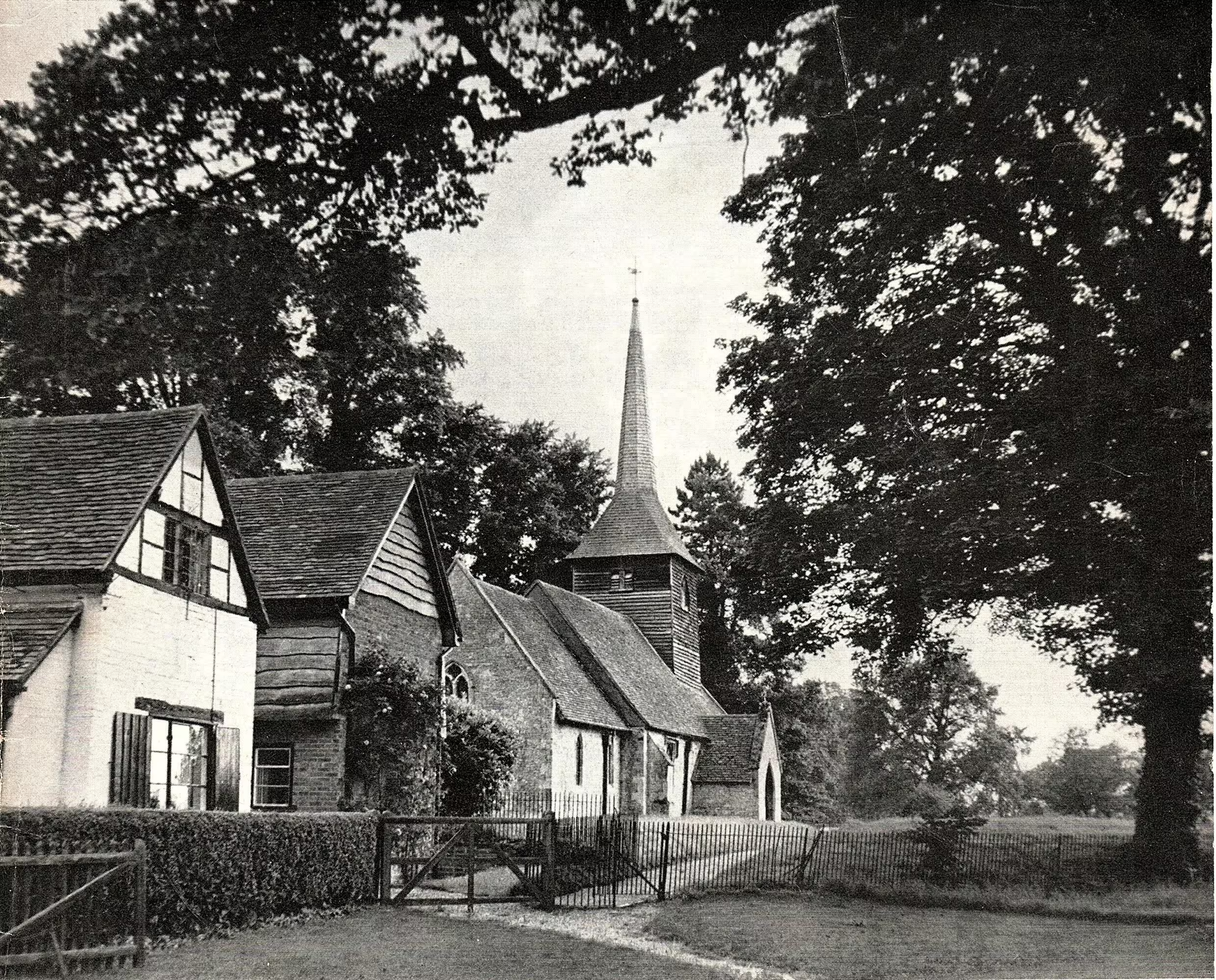
Ilmer and its old vicarage
Historical research from 1998.
Source: Date indicated as 1998 in the text. Supplied via Chris Kingham from Princes Risborough Area Heritage Society and Tristan Batory, partner at JNP estate agents. Rescued at the time of a vicarage probate. The text includes references to other pieces, the whereabouts of which are unknown.
Author unknown, but possibly John Elliott, 1932-2015.
Ilmer
ILMER AND ITS OLD VICARAGE Ilmer is a hamlet with a population of about 72 people situated at the end of a no-through lane to the south of the Thame-Princes Risborough road near the boundary between Buckinghamshire and Oxfordshire (see map at Enclosure 1 (E1)). It lies on a rise in flat countryside in the Vale of Aylesbury a few miles from the Chiltern escarpment, and its main feature is the 12th. century church of St. Peter with its unusual needle spire.
Evidence of early population of the site is thin. Iron age and Romano-British sherds have been found in the vicinity, but in this, of course, Ilmer is not unique. The relevant Domesday Book entry depicts a thriving community, and a church of such ancient foundation in so small a hamlet might suggest that Ilmer was more populous in the past than it is now. Evidence on the point, however, is lacking. The statement in some topographical works on Bucks that the population was wiped out by the Black Death in 1349 is not supported by any entry in the records of the Bucks Archaeological Society. However, there may be evidence of former house platforms in the hummocky surface of the field to the S.W. of the church and Upper Farm, and there are signs of former occupation in a wood at a place formerly known as Loxton (a name that has now disappeared) about half a mile to the south. There was a manor at Ilmer before the Norman invasion ; at the time of the Domesday Book it belonged to Odo, Bishop of Bayeux. Its site appears to have been roughly where Ilmer House now stands. A moat - formerly used for enclosing cattle, rather than for defensive purposes - still exists in the grounds (see E2). A royal licence to enclose the woods of Ilmer and to make a park was granted to John de Moleyns, Lord of the Manor, in 1336. It was one of more than 50 such in the County (see E3).
A good description of the hamlet, which was designated a conservation area in 1982, is to be found in the Ilmer Character Survey issued by Wycombe District Council in 1997 (see E4). The history of the place-name is discussed in the English Place Name Society publication at E5 and a detailed history of land ownership and church patronage is contained in the Victoria County History (E6) and Lipscomb's History of the County of Buckinghamshire (E7).
Little record of daily life in Ilmer throughout the centuries has survived. The forefathers of the hamlet left no record of their working lives, and it is not until the late 18th. and mid 19th. centuries that official records begin to give an outline of the make-up of the community.
The Posse Comitatus of 1798, (E8), a register of males between the ages of 15 and 60 made with a view to their possible conscription in the Napoleonic wars, lists 6 farmers, 7 servants and 10 labourers at Ilmer, though the widow Mrs. Kingham, listed as the owner of 11 horses, 2 wagons and 4 carts must have been one of the most substantial landowners in the district.
The 1851 census for "Illmire" (E9) lists 4 women and 2 girls, aged 8 and 7, as lace makers, an interesting reflection of a cottage industry widespread in this area at the time. A 12-year old boy is listed as an "errand boy" : one wonders what errands he ran, and to where, in so relatively isolated a community. The population in 1851 was 82, and Kelly's Directory for 1854 records that letters for Ilmer are "received through Princes Risborough at 12 noon on payment of an extra charge of 4d : no regular dispatch". The 1869 Post Office Directory still states that for Ilmer "There is no delivery ; the letters are left at a private house in Longwick". By 1887, however, matters had improved. The Directory for that year records "Letters delivered at 8.15 a.m. Letter box near the church cleared at 8.15 a.m. week days only." One wishes that the letter delivery time were equally early 111 years later. The population of Ilmer in the mid and late 19th. Century, according to the ten-yearly census returns, seems to have reached a peak in about 1841/51. The following are the figures given for successive census years:-
| Date | Residents |
|---|---|
| 1841 | 82 |
| 1851 | 82 |
| 1861 | 79 |
| 1871 | 70 |
| 1881 | 63 |
| 1891 | 48 |
| 1901 | 51 |
| 1911 | 58 |
| 1921 | 64 |
The occupations of the inhabitants listed in the census returns vary little throughout this period. The men, with very few exceptions, are farmers, agricultural labourers, or servants. The women are lacemakers, servants, or are vaguely described as farmers' workers. A bootmaker makes a solitary entry in one census return. The pattern of agriculture, cottage industry, and domestic service remains strikingly unbroken. Rather pathetically, later surveys begin to record some inhabitants as "pauper, formerly lace-maker". These are all old women, for whom perhaps failing eyesight or other infirmities had brought hard times. A striking feature of the returns is how immobile the population was. Almost without exception, everyone had been born in Ilmer or in neighbouring villages such as Saunderton, Kingsey, Towersey, Longwick or Horsenden. A resident who had been born as far afield as Wendover stands out almost as a foreigner.
Some idea of the nature of changing social circumstances in Ilmer can be gained from the burial register from 1814 - 1993, a copy of which is at E 10. This shows the dramatic drop in infant mortality after the early years of the 20th. century : in the century from 1814 - 1913, 29 out of 104 burials (28%) were of infants of 5 years or less, whereas in the 80 years from 1914 - 1993 only 4 out of 71 burials (6%) were of infants. It is also interesting that three names take up over a third of all entries : 26 Kinghams, 21 Gommes and 13 Goodchilds.
A feature of 19th. century Ilmer was the long incumbency of the Rev. W.E. Partridge, who was instituted in 1833, a year after his graduation from Oxford, and remained vicar until 1886. Mr. Partridge and his wife bore the entire cost of the restoration of the church in 1859 and 1860, and established a school at Longwick. He lived at Horsenden House and was obviously a man of means, but philanthropically inclined. A memorial to him, in Latin, is built into the north wall of the church (see photograph at E11).
The needle spire of the church, which forms a landmark for some distance around the hamlet, was built in 1909. Kelly's Post Office Directory of 1869 says that "The church of St. Peter is small, in the Perpendicular Style, consisting of nave, chancel, porch, and an unsightly wooden belfry, containing 3 bells....." The photograph at E11 shows the church before the tower was built.
Maps and photographs of Ilmer over the last 160 years show changes of detail rather than of real substance. The tithe map of 1839 (E 12) shows the buildings of Lower, Upper, and Manor Farms much in their present positions, but also shows a Middle Farm on the site of the present September and October Cottages next to The Old Vicarage. As this farm no longer exists, it must at some subsequent date have been incorporated in one or more of the neighbouring properties and the farmhouse converted to two cottages. The 1880 Ordnance Survey map (E 13) shows more woodland and orchard than there is now, and a few buildings (farm outbuildings, perhaps) which have since disappeared. The 1921 map is strikingly similar, though by this year Ilmer House appears to have been built, but is un-named. By 1976 (E 14) nurseries had appeared to the NW of the church (these have subsequently been discontinued) and the buildings of Lower Farm had been considerably extended, probably during the period this property was used as an experimental farm by Shell. In all essentials of shape and size, however, little has changed since the early 19th. century and probably for much longer. The railway line from Princes Risborough to Bicester, Banbury and Birmingham which was built in the early 20th. century crosses Ilmer Lane immediately to the N.E. of Lower Farm and must have seemed a strange intrusion into so isolated a settlement. A halt was opened at Ilmer on April 1st. 1929 (see E 15) probably with the transport of agricultural produce to neighbouring towns and markets in mind. The halt was closed to passengers on 7 January 1963 following the removal of one of the railway tracks as part of the Beeching cuts : the second track was reinstated in 1998.
Ilmer's place in Buckinghamshire folk lore has been secured by its hermit - one Charlie Belgrove, a recluse who lived in a converted henhouse in a field not far from the hamlet until his death in 1968. His story is told at E 16.
The hamlet's social life centres around the church and annual events such as barbecues, pig roasts and barn dances. In 1995 the 50th. anniversary of VE Day was celebrated by a barbecue party on the village green, and a display of wartime memorabilia in the church (E 11). In October 1996 the church and churchyard were converted by means of fleece and artificial snow into the backdrop for a Swiss marriage scene for the film "Photographing Fairies" (E11). One wonders what future such excitements lie in store.
The Old Vicarage A vicarage appears to have been on the present site to the east of the church for probably at least 400 years. A survey of all the possessions belonging to the vicarage of Ilmer, dated 1607, refers to "The Homestall or scite of the Vicarage situate on the East part of the Church consisting of 4 Bayes, built all with wood and covered with Tyles. Two Bayes thereof being chambered and boarded, disposed into four Rooms (viz) A Hall, a Kitchin, a Parlour & a low Chamber. A Little Close next the street. The Close called the Vicars Wood-yard. One stable. A little Close with an apple tree in it, joyning ot the Vicaridge House. All these containing by Estimation One half Acre." A photocopy and transcription of this survey are at E 17.
The 1607 description does not fit the old part of the building, however, and it seems likely that the vicarage was rebuilt some time in the 17th. century, (a conjecture supported by a church inspection report of 1637, "The Vicarage house in decay") and substantially altered in the 18th. The section on Ilmer in the 1912 report by the Royal Commission on Historical Monuments (E18) refers to a "Cottage, said to have been formerly the vicarage, on the E. side of the churchyard, is of two storeys, built of brick and timber in the 17th. century, now much restored. The roof is tiled. One room has a wide fireplace and old beams in the ceiling. Condition - fairly good." One expert on vernacular architecture who has visited the building has dated it to the early 17th. century, another to the early 18th. century, though with the possibility that some 17th. century features may have remained incorporated. The old window furniture and door hinges still remaining correspond to 18th. century patterns.
The house has not been lived in by a resident vicar for over 250 years. The record of a church visitation in 1712 states that "The vicar resides in his Vicarege house" (see extract from record of church visitations at E 19) but the last resident vicar was Henry Stanbridge who was the incumbent from 1722 - 1746 and who was buried at Ilmer on 28 June 1746. It seems likely that the house was let to tenants shortly thereafter, unless any of the curates recorded as having served the church from 1763 lived there. Lipscomb records that in 1816 it was said that "the glebe house (was) very small and inconvenient" and a tithe map of "Illmire" of 1839 (E 12) shows the house and garden, owned by the vicar, the Rev. William Partridge, but occupied by Jesse Gomme at a rent of 6s. per annum. The 1841 census showed the "Vicarige House" to be occupied by
- Jesse Gomme (42) Agricultural labourer
- Charlotte Gomme (34) Lacemaker
- Eli (16)
- Josse (10)
- John (7)
Jesse Gomm was still in occupation when the 1851 census was taken, together with Charlotte and two of the sons, now aged 17 and 19. Jesse and Charlotte, now 62 and 53 respectively, are listed in the 1861 census, but Jesse died on 18 December 1867 and in 1871 the Vicarage House was occupied by
- Charlote Gomm (63) Pauper
- Ann Mead (46) Daughter, agricultural labourer's wife
- Emma Gomm (11) Grandaughter
One wonders where Ann Mead was in 1841, when she would have been 16 (in service at a house out of the parish, perhaps?) and why both Ann and Emma (who was presumably the daughter of one of the two sons listed in the 1841 and 1851 surveys) were living with Charlotte rather than with their own families. Moreover, how did such a household support itself? The 1881 Census does not record a Charlotte Gomme, who must either have died or moved out of the hamlet by that date, and does not designate the occupants of the Old Vicarage as such. In 1891, however, there is an entry following "Illmere Church" which lists a Thomas and Mary Goodchild, aged 28 and 30 respectively, with a daughter of 3 and a son of 2. It seems likely that this family lived in the Old Vicarage.
The 1880 Ordnance Survey map on a scale of 25 inches to a mile (E 13) shows the garden of the vicarage, with its miscellaneous outbuildings, as occupied by trees, as does the 1921 edition (E ). The house continued to be tenanted : in 1903 by Thomas Goodchild, a farmer, and by 1911 - and until at least 1915 - by a Miss A. Philips. A parish room was built in 1908 at the expense of Miss Moreton, lady of the manor and principal landowner, on a site now occupied by the Old Vicarage garage approach. An interesting photograph of the church and the Old Vicarage, believed to have been taken about 1910 (E 11) shows the house with a hedge at the front and no window on the north side of what is now the TV room. The small extension containing this window must have been built a later date, as is also evidenced by the different exterior brickwork, though the window frame itself shows much earlier features. By the 1920s the continued ownership of the vicarage was clearly thought to be of no advantage to the church and there is reference to its proposed sale in correspondence of the period 1923-25. The vicarage passed out of the hands of the church in 1927 when it was sold to Mr. Albert Goodchild, the occupant of Ilmer House, for £325. The conveyance was from the then rector of Horsenden cum Ilmer, the Rev. W.M. Tuke, with the approval of the Ecclesiastical Commissioners and the consent of the patron (one Mrs. Clara Jaques of Horsenden House, Princes Risborough). The conveyance was accompanied by a statutory declaration (presumably in the absence of title deeds for so ancient a property) by 73-year old Mr. Stratfold Read of Saunderton to the effect that to his knowledge the premises had formed part of the glebe land of the church for the last forty years. The vicarage was, as might be expected, still tenanted : the conveyance records that the house was occupied by a Mr. Fitzwilliam Kingham, whereas Mr. Tuke lived in High Wycombe.
Albert Goodchild died in 1931 and The Old Vicarage passed in his will to his widow, Elizabeth Goodchild, who in 1933 married Charles Keene at Epsom Register Office. In 1946 Elizabeth Keene, as she had then become, sold The Old Vicarage and two other parcels of land she owned at Ilmer to a Mr. Dudley Leuw of London, described in the conveyance as a gentleman. The Old Vicarage and a piece of land of 1 acre and 3 roods to the north of the house were combined for the purposes of this sale at an agreed price of £1100.
The setting of the house bought by Mr. Leuw would have been different in a number of respects from today's. 19th. century maps show a projection on the west side (nearest the church) which would presumably have been an entry porch where there is now a doorway between the dining room and the hall, but an aerial photograph of 1946 (E 1) shows (with the aid of a magnifying glass) the pathway to the house to lie on its east and south sides so that the entry door would presumably have been where the archway between kitchen and breakfast room is now situated. The garden at that time appears to have been cultivated in a series of beds, perhaps as a relic of the wartime Dig for Victory campaign, so most of the trees presumably disappeared sometime between 1921 and 1946.
It would have been during Mr. & Mrs. Leuw's ownership of the property that the hall and drawing room extensions were built. In March 1968 Mr. Leuw made a gift of a half share of all his property in Ilmer to his wife Margaret Leuw, and in October 1969 Mr. & Mrs Leuw sold The Old Vicarage to a Mr. John Prior of Northwood, Middlesex, for £14,900. Mr Prior subsequently bought the Parish Room (referred to above) from the Diocesan Trustees in August 1971 for £300, presumably in order to demolish it and thus to facilitate the erection of a garage with living accommodation above for which he had been granted planning permission in September 1970. The work was not however put into effect before the house was sold in May 1972 to Mrs. Barbara Richards.
Mrs. Richards remained at The Old Vicarage for 16 years, already with an established reputation as a gardener : awards of merit given to her for delphiniums are still on display, albeit somewhat faded, in the workshop, and the bird cherry trees in the road verge opposite the house are also said to have been planted by her. Mrs. Richards also put into effect revised plans for a kitchen extension (the breakfast room) and for a new garage and utility room (without, however, the living accommodation above foreseen by Mr. Prior). In 1988 she sold the property to a Mr. & Mrs. Seward.
There then followed two short occupancies. The Sewards sold the property to Mr. & Mrs. Markeson in January 1992, and the Markesons to the Elliotts on July 1993. A plan of the house in its 1993 form is at E 20.