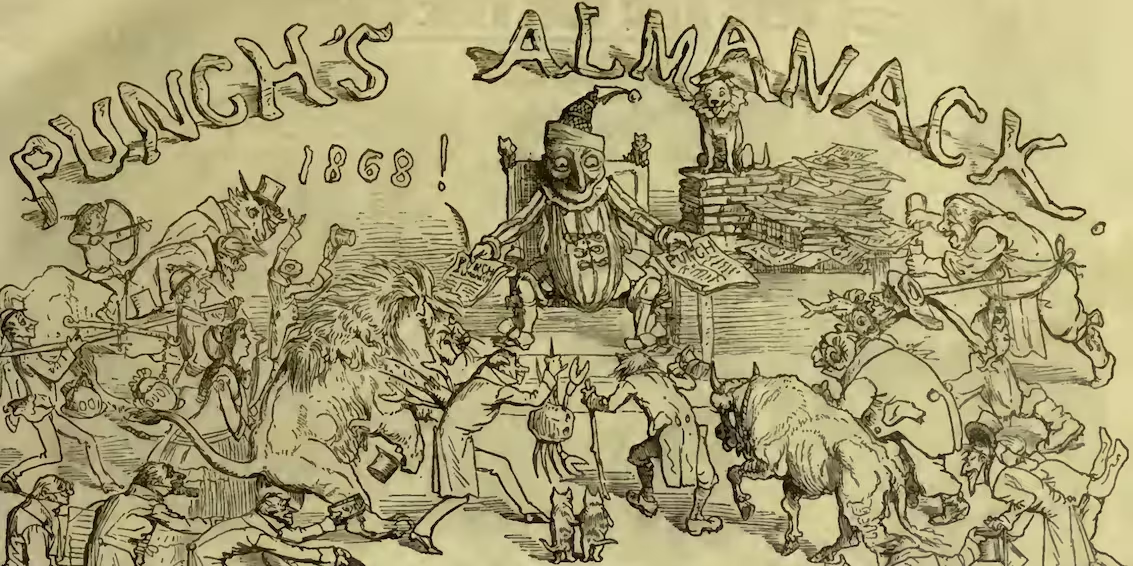
Population
The population of Ilmer
A village that 'marks time' - The Daily Sketch
The Daily Sketch was a British tabloid newspaper published from 1909 to 1971. It was known for its extensive use of photographs and illustrations. In 1935, they ran a feature on the village of Ilmer.
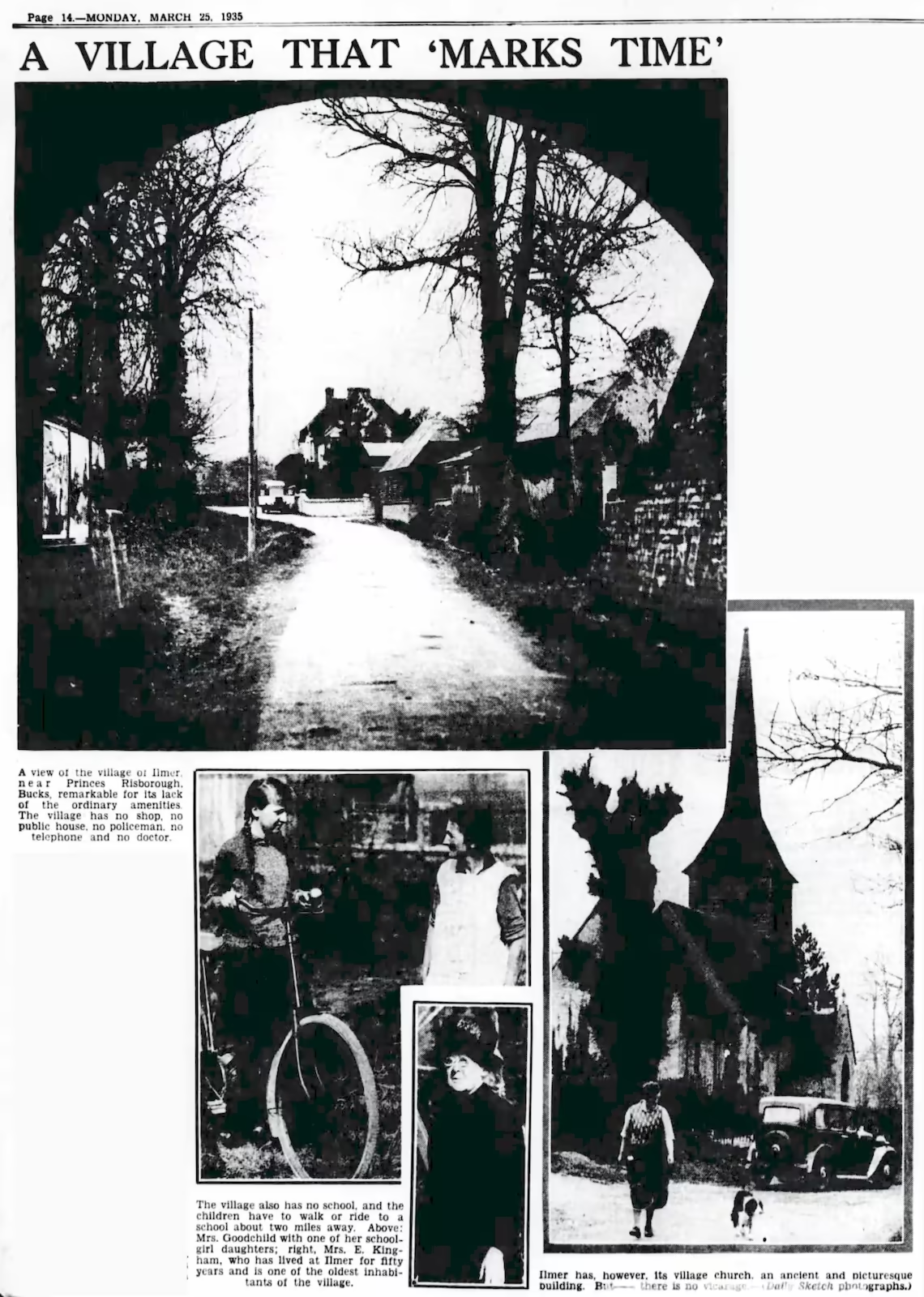
Elizabeth Kingham née Claydon, married William Kingham of Ilmer and lived in one of the 3 cottages known as Close End Cottages. Widowed in 1929, she died in 1939 aged 76. Mrs Goodchild is likely to be Annie Goodchild (née Smith), wife of Harry, a stockman. The daughter is likely to be Elsie Dorothy Goodchild who married Gerald Knight.
The vehicle pictured is probably a Morris Eight saloon produced between 1935 and 1948. The same, or another similar vehicle can be seen in a 1948 aerial photo from Historic England.
Overseers of the poor
Before the modern welfare system, each parish was responsible for helping local people who were poor, elderly, ill, disabled or unable to work. This work was carried out by officials known as Overseers of the Poor.
The overseers collected money from local taxpayers and used it to provide practical help, such as food, clothing, rent, medical care or small cash payments. They might also arrange work for unemployed people, place children as apprentices or help manage a parish workhouse.
The following list of Overseers is taken from the Church Mounds[1]
| Period | Incumbent | Role |
|---|---|---|
| 1736-1737 | Thomas Kingham and Thomas Messenger | Overseers |
| 1737-1738 | Thomas Messenger and John Woolvin | Overseers of the poor |
| 1738-1739 | Thomas Kingham and Joseph Kingham | Overseers of the poor |
| 1739-1741 | Thomas Buttler and Joseph Kingham | Overseers of the poor |
| 1741-1743 | Thomas Kingham and Thomas Messenger (signed as ‘the mark’ of Thomas Kingham) | Overseers of the poor |
| 1743-1744 | Thomas Buttler and John Woollvin | Overseers of the poor |
| 1744-1745 | Thomas Buttler and Thomas Kingham | Overseers of the poor |
| 1745-1747 | Thomas Kingham and John Woollvin | Overseers of the poor |
| 1747-1748 | Joseph Kingham and Thomas Messenger | Overseers of the poor |
| 1748-1750 | Thomas Buttler and Joshua Kingham | Overseers of the poor |
| 1750-1751 | John Nickols and John Kingham | Overseers of the poor |
| 1751-1753 | Thomas Buttler and John Kingham (signed as ‘the mark’ of John Kingham) | Overseers of the poor |
| 1753-1755 | Joshua Kingham and John Nickols | Overseers of the poor |
| Missing | ||
| 1757-1758 | ? Gomm and Joshua Kingham | Overseers of the poor |
| Missing | ||
| 1760-1761 | John Kingham and John Nickols | Overseers of the poor |
| 1761-1762 | John Nickols and Joshua Kingham | Overseers of the poor |
| 1762-1764 | Thomas Kingham and Joshua Kingham | Overseers of the poor |
| 1764-1765 | Thomas Kingham and The Widow Kingham (Thomas and John Kingham were chosen the previous year, indicating John died in office) | Overseers of the poor |
| 1765-1779 | Thomas Kingham and Joshua Kingham | Overseers of the poor |
| 1779-1796 | Thomas Kingham and John Kingham | Overseers of the poor |
| 1796-1802 | John Kingham of Middle Farm and John Kingham of Lower Farm | Overseers of the poor |
| 1802-1804 | John Kingham of Middle House and John Kingham of Lower House | Overseers of the poor |
| 1804-1811 | Elizabeth Kingham and John Kingham of Lower Farm | Overseers of the poor |
| Missing | ||
| 1813-1814 | Stephen Read | Overseer of the poor |
| 1814-1815 | Richard Kingham | Overseer of the poor |
| 1815-1816 | John Gomm and John West | Overseers of the poor |
| 1816-1817 | Thomas Alan and Ann Wooster | Overseers of the poor |
Surveyor of Highways
Before roads were maintained by councils, each parish was responsible for looking after its own highways. This work was organised by a local official known as the Surveyor of Highways.
The surveyor inspected roads, bridges and ditches, arranged repairs and made sure that routes remained passable. Local landowners and householders could be required to provide labour, carts, horses or materials such as stone and gravel.
....coming soon....
Notable office holders
Sarah Wooster
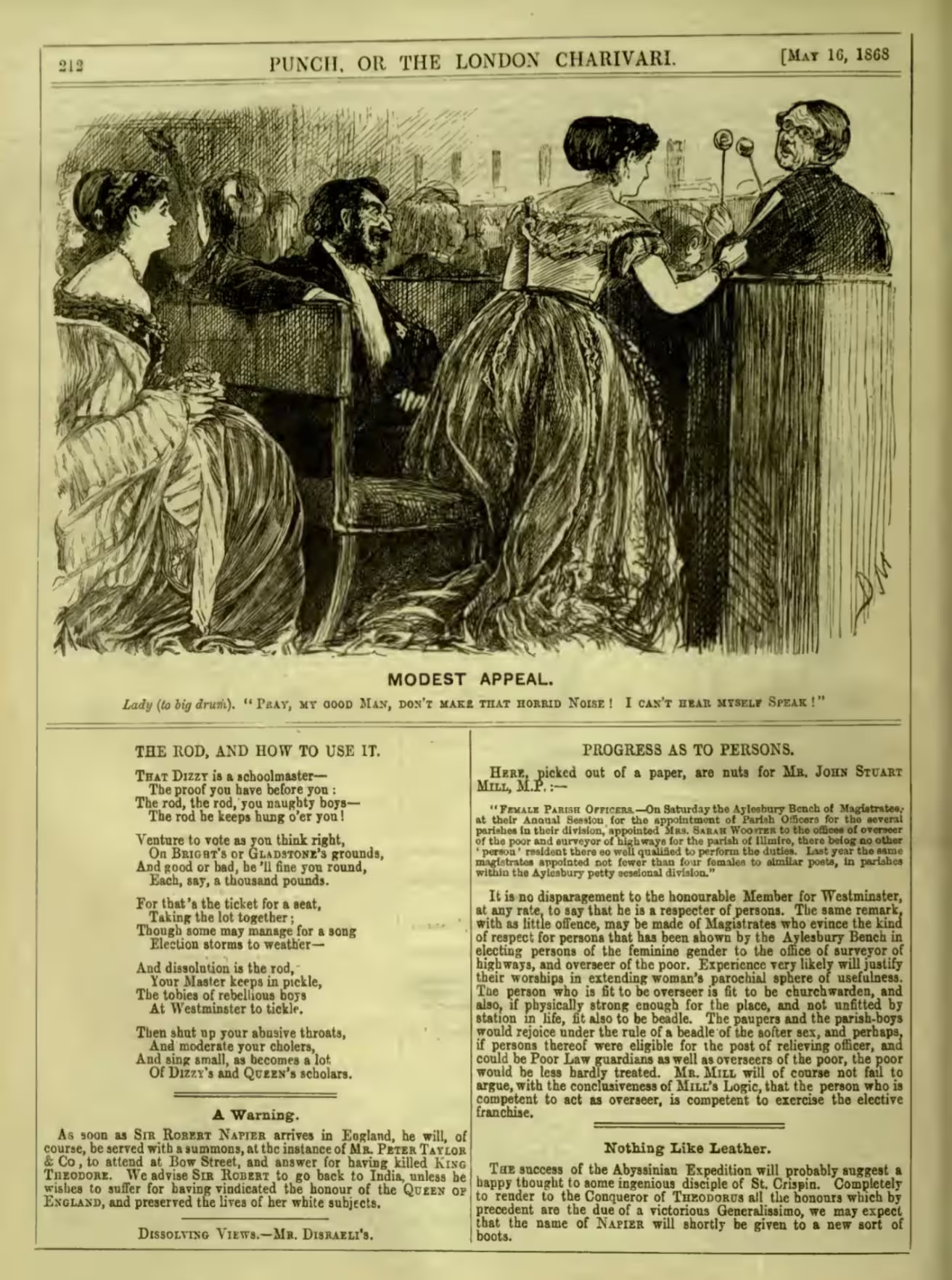
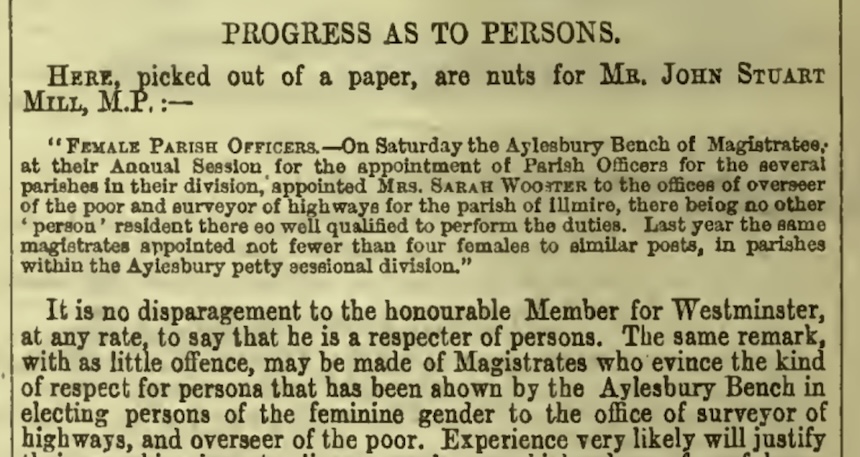
Widowed in 1863, Sarah was appointed Surveyor of Highways in 1864[2] and in March 1868 appointed as Overseer of the poor and Surveyor of the highways. Having a woman in such a role was so unusual, the story was picked up by newspapers both nationally and internationally reaching as far as the Trinidad Chronicle[3]
On May 16 1868, Punch magazine covered the story[4], relating the role of Sarah Wooster to the women’s suffrage movement and the equality of sexes as campaigned for by John Stuart Mill MP - famous for his 1869 essay The Subjection of Women.
Later on the same year Sarah requested her four youngest sons be prosecuted for fighting each other. [5]
ILLMIRE
UNNATURAL SONS. — On Wednesday, at the Risborough petty session, (before the Rev. W. E. Partridge,) Daniel, Joseph, Frank, and George Wooster were brought up at the instance of their mother, Mrs. Sarah Wooster, who asked that they might be bound over to keep the peace. Mr. John Eggleton, parish constable, stated that on Sunday morning, the 26th ult., the defendants were quarrelling in their mother’s house, and there was blood on them as if they had been fighting. They were each ordered to enter into their own recognisances in £10 to keep the peace for twelve months.
Ilmer Councillors
(source: A History of Longwick, Joyce Cunningham, 2001)
| Years | Incumbent | Role |
|---|---|---|
| 1894 - 1899 | Richard Belgrove | Overseer/First Chairman? |
| 1894 - 1897 | Rev John Ormond | Vice Chairman |
| 1895 - 1899 | Alfred Hill | Overseer (half-year rates collector) |
| 1895 - 1896 | George Gomme | Chairman |
| 1899 - 1911 | Rev J E Varley | Overseer (half-year rates collector) |
| 1900 - 1905 | George Kingham | Overseer & Constable (1903 - 1905) |
| 1900 - 1903 | Thomas Goodchild | Overseer & Constable (1903) |
| 1903 - 1905 | George Gomme | Overseer (half-year rates collector) |
| 1903 - 1912 | Fritz William Kingham | Constable & Overseer (1908 - 1909) |
| 1905 - 1908 | Richard Belgrove | Overseer |
| 1905 - 1906 | Alfred Hill | Overseer |
| 1906 - 1923 | Thomas Goodchild | Constable |
| 1906 - 1909 | WCook | Overseer |
| 1908 - 1909 | George Gomme | Constable |
| 1909 - 1914 | George W Kingham | Overseer |
| 1909 - 1910 | Thomas Belgrove | Overseer |
| 1909 - 1910 | J Stratford | Constable |
| 1911 - 1912 | George Gomme | Chairman |
| 1912 - 1916 | Albert Goodchild | Overseer |
| 1912 - 1918 | Rev HM Gorham | Chairman & Overseer (1916- 1918) |
| 1914 - 1916 | Alfred Hill | Overseer |
| 1916 - 1917 | George Gomme | Overseer |
| 1917 - 1918 | Thomas Goodchild | Overseer |
| 1918 - 1920 | Albert Goodchild | Overseer |
| 1918 - 1921 | Rev W O'Connor | Chairman & Overseer (1918 - 1921) |
| 1919 - 1921 | John B Bailey | Assistant Overseer (died in office Oct 1921) |
| 1920 - 1921 | Alfred Hill | Overseer of the Poor |
| 1921 - 1926 | Rev Wm Magee Tuke | Chairman |
| 1921 - 1927 | Frederick Ward | Overseer of the Poor |
| 1921 - 1922 | Thomas Bradshaw | Overseer of the Poor |
| 1921 - 1927 | Robert Bailey | Assistant Overseer & first Parish Clerk - 1927 |
| 1922 - 1923 | Alfred Hill | Overseer of the Poor |
| 1923 - 1929 | Fritz William Kingham | Constable & Overseer (1923 - 1927) |
| 1923 - 1935 | Harry Goodchild | Constable |
| 1926 - 1932 | Albert Goodchild | Chairman (died in office 1931-2) |
| 1929 - 1930 | Edward A Goodchild | Constable |
| 1930 - 1933 | Geoffrey Brian Quint | Constable |
| 1932 - 1934 | George Gomme | Chairman |
| 1933 - 1934 | Thomas Tucker | Constable |
| 1934 - 1935 | William Frederick King | Constable |
At this point, Ilmer joined with Longwick to become Longwick-cum-Ilmer.