Parish Records
Registers and records of St Peter's Ilmer
The document below is a faithful transcription of the original parish records, preserving inconsistencies including variant name spellings (Keen/Kearn) and historical dating errors such as "Nov 31".
Burials
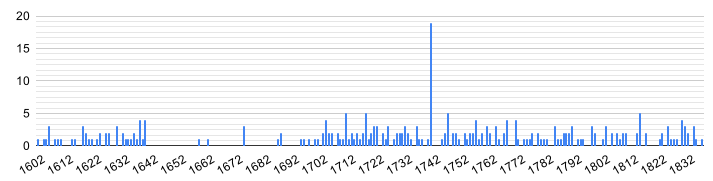
Between 1641 and 1700, burial records are sparse. While the Great Plague of 1665–66 accounts for some of this gap, it cannot explain the 59-year shortfall. The parish maintained at least 3 vicars during this period, indicating the church remained active despite incomplete record-keeping.
In 1741, there were a surprising number of burials consisting of:
- Blizard × 1
- Browne × 1
- Bucklands × 4
- Gomm × 3
- Surman/Syrman × 2
- Woollven/Woolvin × 6
- Meade/Meads × 1
- Munday × 1
The records show that 1741 was a year of exceptionally high mortality for the parish, particularly in May and November. The Woolvin family was hit hardest, with six members (including four children and the mother, Margaret) buried within a single month between October 26th and November 23rd. Similarly, the Buckland family lost four members (William, Sarah, John, and another William) in late May of that same year.
Overall, 268 burials are recorded at an average rate of 1.14 per year.
Marriages
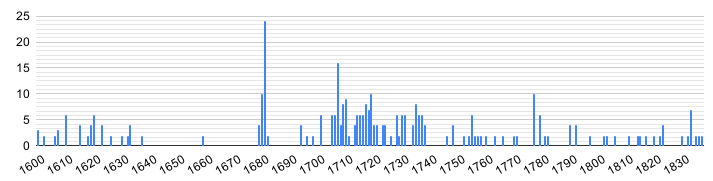
Overall, 369 marriages are recorded at an average rate of 1.55 per year.
Baptisms
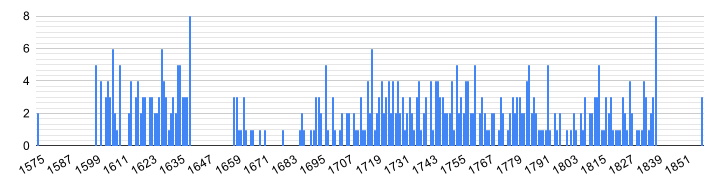
Overall, 450 baptisms are recorded at an average rate of 1.58 per year.
Interesting discoveries
A Recorded Suicide: On June 13, 1704, the burial of Mary Gomm was recorded with the grim note: "who laid violent hand upon her selfe."
The "Base Born" and Lacemakers: There are numerous records of "base born" or "illegitimate" children. Interestingly, in the 1820s–1840s, the mother's occupation is frequently listed as "lacemaker".
Simultaneous Deaths: The burial register occasionally hints at untold tragedies, such as sudden illness or accidents. On May 14, 1740, husband and wife Edward and Elizabeth Oxley "were both buried" on the exact same day
The Burying in Woollen Acts 1666-1680 were acts of parliament requiring the dead to be buried in English woollen shrouds designed to force people to buy English wool to prop up the textile industry. The law was eventually changed in 1814. The notes on the transcript states that who was buried in such a way is omitted from the transcript.